How Are Calories in Food Measured?

How do food manufacturers measure the calories in food? How do they know what to put on nutrition labels? Ask Science discusses several methods of calorie measurement (and explains why they’re all problematic).
Lee Falin, PhD
Listen
How Are Calories in Food Measured?
 At some point in your life, you’ve probably been a calorie counter, if only for a moment.
Have you ever looked at a food nutrition label and wondered what exactly a calorie is? Everybody knows that foods high in calories are supposed to be worse for you, right? Or is that only when you are dieting?
Let’s look at some of the science behind calories to see what’s what.
.
What Is a Calorie?
In scientific terms, a calorie is a unit of energy, just like a meter is a unit of distance, or a gram is a unit of mass. One calorie is the amount of energy you need to raise 1 gram of water 10 Celsius.
So if you had an 8-ounce cup of water (which would be about 224 grams of water), and you wanted to make it 50 warmer, you would need 224 x 5 calories, or 1,120 calories.
Now one thing you should know is that in the United States, when a food label says that a candy bar has 300 Calories, those Calories are spelled with a capital C. This is sometimes called a “nutritionist calorie,” but in reality it means a kilocalorie, or 1,000 calories.
If you look at a food label in Europe, unless it’s imported food from the U.S., it will show the number in kilocalories.
For the conscientious calorie counter, keep in mind that neither of these caloric measurements necessarily tell you how many calories are in the entire candy bar. In the U.S., the measurement is the amount of kilocalories per serving (which varies from package to package), while in Europe it is how many kilocalories per 100 grams. European labels also usually have a measurement in kJ or kilojoules, which is just another unit used to measure energy (1 calorie is about 4.2 joules).
How Are Calories Measured?
So now that you know what a calorie is, let’s talk about how a calorie is measured.
To measure the calories in a random candy bar, all you have to do is dehydrate it, then burn it. While it’s burning, just measure how much heat energy it gives off, and that will tell you how many calories it has—super easy!
While that might seem crazy, that’s really how it’s done. Remember what we said about a calorie being the amount of energy required to raise 1 gram of water 10 Celsius? To measure the heat given off when you burn your candy bar, first place it inside a metal can, then place that metal can inside of an insulated container of water. Then stick a thermometer in the water, seal the whole thing up, and you have what is called a calorimeter.
As the candy bar burns, the heat goes through the metal container, and heats up the water. If you know how much water you have, you can just measure how high the temperature gets, and use that to calculate the energy.
Of course, real life calorimeters are slightly more complicated than that, but this gives you the basic idea.
Do We Really Have to Burn Food to Measure Calories?
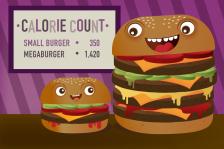 Well, no. While the above method does give you the true amount of calories in a candy bar, it doesn’t give you the full amount of calories that your body gets from the candy bar. That’s because not all of the food you eat is metabolized by your body. Some of it (such as fiber) is lost in the form of waste.
So food labels use one of two methods to measure calories. Method one is to use what is called the Atwater system, which involves a bunch of mathematics to determine how much energy is in each gram of fat, carbs, and protein in a food, then subtracts how much of those calories are expected to be lost in bodily waste. However this is both somewhat tedious and has been shown to be rather inaccurate.
The FDA also allows a simpler method for food manufacturers. They can look at their ingredients and determine how many grams of fat, carbohydrates, and protein they contain, and then assume that each gram of protein and carbohydrates gives 4 kilocalories, while each gram of fat gives 9. Then you subtract 4 kilocalories for every gram of fiber, and you have your official, government sanctioned calorie measurement.
How Accurate Is That System?
Now you might be wondering, after all of that scientific talk, how accurate is this 4, 4, 9 method? Well, not very. In fact, the higher the amount of fiber in the food, and the lower the fat, the more overestimated the calorie count tends to be.
Plus, not everyone’s body metabolizes at the same level of efficiency. Certain genetic conditions and illnesses can cause foods to be metabolized differently by some people than others, so what might be a 100 Calorie snack for you, might only be an 80 Calorie for your friend (or vice versa). And as Nutrition Diva taught us, all calories are not created equl.
Conclusion
So now you know more about calories (and Calories), how they’re calculated, and why you should pay even less attention to caloric estimates than you did before. Check out Nutrition Diva’s show to learn more about how to maintain a healthy weight without counting calories.
If you have a question that you’d like to see on a future episode, send me an email at everydayeinstein@quickanddirtytips.com. If you liked today’s episode, you can become a fan of Ask Science on Facebook or follow me on Twitter, where I’m @QDTeinstein.
Chocolate Bar image, meineresterampe at Pixabay. CC BY CC CCO. Hamburger graphic courtesy of Shutterstock.